
Palliative Care: Comprehensive Pain and Symptom Management
Pain in serious illness deserves the same expert attention as the illness itself. We work alongside your specialist team to ensure you are comfortable and retain your quality of life at every stage.
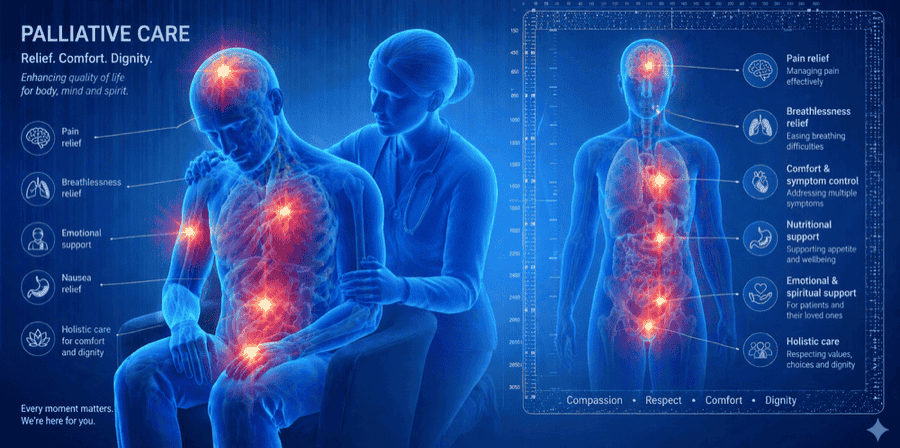
Palliative care is specialised medical care focused on relieving suffering and improving quality of life for patients with serious, life-limiting illness. Pain is its cornerstone. Getting pain under control is not a luxury — it is a clinical priority that affects every aspect of how a patient lives with their illness.
What Is Palliative Care Pain Management?
Palliative care pain management addresses the complex, often mixed pain syndromes that arise in serious illness. Unlike standard pain management, palliative pain care must account for rapid fluctuations in condition, the need to minimise additional medication burden, the patient's goals and preferences, and the family's role as active participants in care.
Dr. Ashu Kumar Jain works alongside oncologists, cardiologists, nephrologists, respiratory physicians, and neurologists to provide a pain management layer that integrates seamlessly with the patient's existing care. The goal is not merely to reduce a pain score — it is to restore the patient's ability to engage meaningfully with their family and with each day.
Palliative pain management uses the full range of tools: optimised medications, interventional procedures that can dramatically reduce opioid requirements, and psychological support for pain that carries anxiety, fear, and anticipatory grief alongside its physical dimensions.

Palliative Care Can Start at Diagnosis, Not Just End of Life
One of the most persistent and harmful misconceptions about palliative care is that it is synonymous with dying. This misunderstanding causes patients and families to decline palliative care referrals until the very last weeks of life — exactly when establishing an effective pain management plan is hardest.
Evidence from multiple clinical trials, including a landmark study in metastatic lung cancer, shows that early integration of palliative care alongside standard oncological treatment produces better symptom control, better mood, greater patient satisfaction, fewer emergency admissions, and in some cases longer survival.
Palliative care is about quality of life. It is appropriate at any stage of a serious illness and does not preclude curative or life-prolonging treatment. Starting it early means starting it when the patient has the most capacity to benefit from it.
Conditions We Provide Palliative Pain Management For
- Advanced Cancer: All cancer types, including pain related to primary tumour, metastases, treatment-induced neuropathy, and bone pain from skeletal deposits.
- Heart Failure: Refractory chest pain, breathlessness-related distress, and peripheral pain syndromes associated with advanced cardiac disease.
- Chronic Obstructive Pulmonary Disease (COPD): Musculoskeletal chest pain, rib fracture pain from coughing, and breathlessness-associated anxiety.
- End-Stage Renal Disease: Neuropathic pain, pruritus, restless leg syndrome, and musculoskeletal pain in patients on dialysis or in conservative kidney management.
- Neurological Conditions: Motor neuron disease (ALS/MND), Parkinson's disease, multiple sclerosis — all producing significant pain and discomfort at various stages.
- Dementia with Behavioural and Psychological Symptoms: Pain is a major driver of agitation and distress in advanced dementia. Properly treated pain can dramatically reduce the need for sedative medications.

How Is Palliative Pain Assessed?
Palliative pain is rarely a single entity. Patients commonly have multiple simultaneous pain syndromes — bone metastasis pain, soft tissue infiltration pain, procedure-related pain, and treatment-induced neuropathy all at the same time. A thorough assessment identifies each component and targets it appropriately.
- Detailed pain history including site, character, timing, aggravating and relieving factors
- Current analgesic review including opioid dose, side effects, and adequacy of breakthrough coverage
- Assessment for neuropathic, visceral, and somatic pain components requiring different treatment strategies
- Review of relevant imaging to identify structural targets amenable to interventional procedures
- Discussion of patient's goals, preferences, and home situation to plan the most appropriate management
Check If You Need This Treatment
I have pain from a serious, life-limiting illness
Pain significantly affects my quality of life or ability to rest
Oral pain medication is not providing adequate relief
I or my family member has advanced cancer, heart failure, COPD, or renal failure
I would benefit from home visit pain consultations
What we offer?
Our approach to palliative pain management
We combine medication optimisation with targeted interventional procedures to minimise the opioid burden while maximising pain control.
 Coeliac Plexus Block for abdominal visceral cancer pain — pancreatic, gastric, hepatobiliary and other upper abdominal cancers
- Superior Hypogastric Plexus Block for pelvic cancer pain from colorectal, cervical, ovarian, bladder, and prostate malignancies
- Intrathecal Drug Delivery (spinal pump) for refractory cancer pain that requires high-dose systemic opioids, reducing total opioid burden by up to 300-fold
- Nerve Blocks for Localised Pain Syndromes including intercostal blocks for rib metastases and thoracic wall pain
- Subcutaneous Opioid Infusion for patients unable to tolerate the oral route due to nausea, dysphagia, or intestinal obstruction
- Ketamine Infusion for complex neuropathic and opioid-refractory cancer pain

Frequently asked questions
Does choosing palliative care mean giving up on treatment?
No. Palliative care runs alongside curative or life-prolonging treatment — it does not replace it. A patient undergoing chemotherapy, radiotherapy, targeted therapy, or dialysis can and should receive palliative care simultaneously. Palliative care addresses pain and other symptoms so that patients can tolerate their primary treatment better and maintain quality of life throughout it.
What does an intrathecal drug delivery system involve?
An intrathecal drug delivery system (spinal pump) delivers opioid medication directly into the fluid around the spinal cord, where it is needed. Because the drug reaches pain receptors directly, the dose required is far smaller than oral or intravenous doses — typically 1/300th of the equivalent systemic dose. This dramatically reduces side effects such as sedation, constipation, and nausea, while providing superior pain relief. It is considered when systemic opioids are no longer controlling pain or are causing intolerable side effects.
Can a coeliac plexus block help with pancreatic cancer pain?
Yes — the coeliac plexus block is one of the most effective interventional procedures for upper abdominal cancer pain, particularly pancreatic cancer. Pain signals from the upper abdominal organs travel through the coeliac plexus. Blocking or neurolysing this plexus interrupts these signals and can provide profound, durable pain relief, often allowing a significant reduction in opioid dose. It is performed under CT or fluoroscopic guidance and takes about 30 minutes.
When should we ask for a palliative pain specialist?
You should ask for a referral when: oral pain medications are not providing adequate relief, side effects of opioids (sedation, constipation, nausea) are limiting dose escalation, the patient's pain is described as burning, shooting, or electric (neuropathic), the patient's quality of life is significantly affected by pain, or cancer or disease has spread to the spine, abdomen, or pelvis where targeted procedures may help. There is no reason to wait until pain is severe before seeking specialist input.
Do you offer home visits for palliative patients?
Yes. For patients who are unable to travel to the clinic due to their condition, we offer home visits for pain assessment and medication optimisation, as well as teleconsultation for ongoing review. Certain procedures can also be arranged at home or at a partnering healthcare facility closer to the patient. Please contact us to discuss what is feasible for your specific situation.
Can family members be involved in pain management planning?
Absolutely — and we actively encourage it. Family members and caregivers play a central role in a palliative patient's pain management. We provide education on recognising pain and distress, correct use of breakthrough medication, when to escalate, and how to communicate the patient's pain status to the clinical team. We also offer explicit caregiver support because caring for someone in pain is itself distressing and exhausting.