
Knee Joint Cooled RFA
Knee pain from osteoarthritis can make every step an effort. Cooled RFA of the genicular nerves targets the specific nerves supplying the knee joint, giving you relief that lasts well beyond what injections can offer, without touching the joint itself.
Your journey
Your Road to a Pain-Free Life
Before Your Visit
What to prepare for Knee Cooled RFA.
Key Points
Prior positive genicular nerve block (≥50% relief) is recommended
Stop blood thinners as advised (3–7 days for most)
Bring knee X-rays or MRI from the last 12 months
Arrange a driver home
For females: please remove all jewellery, nail polish, nail caps, and makeup before the procedure
What to Expect
Dr. Jain will confirm that your knee pain is primarily from osteoarthritis and that you have had an adequate trial of prior treatments (injections, physiotherapy, pain medications).

Patient is relaxed and ready for the procedure
← Swipe to explore stages →
Before Your Visit
What to prepare for Knee Cooled RFA.
Key Points
Prior positive genicular nerve block (≥50% relief) is recommended
Stop blood thinners as advised (3–7 days for most)
Bring knee X-rays or MRI from the last 12 months
Arrange a driver home
For females: please remove all jewellery, nail polish, nail caps, and makeup before the procedure
What to Expect
Dr. Jain will confirm that your knee pain is primarily from osteoarthritis and that you have had an adequate trial of prior treatments (injections, physiotherapy, pain medications).
Test your knowledge
How Well Do You Know This Procedure?
How many genicular nerve branches are targeted during standard Knee Cooled RFA?
Frequently asked questions
What are the genicular nerves, and why are they targeted?
The genicular nerves are small sensory nerve branches from the femoral and common peroneal nerves that innervate the knee joint capsule. They carry the pain signals from an arthritic, inflamed, or damaged knee joint to the brain. There are three main targets: the Superior Medial (SM), Superior Lateral (SL), and Inferior Medial (IM) genicular nerve branches. Ablating these nerves interrupts the pain signal without affecting the joint's structure, mechanics, or surrounding muscles.
What makes Cooled RFA different from conventional RFA?
In conventional RFA, the probe tip reaches 80°C and creates a relatively small lesion. In Cooled RFA, internal water cooling circulates around the probe tip, keeping it cooler while allowing the surrounding tissue to reach ablation temperature. This creates a significantly larger and more spherical lesion, important for the genicular nerves because they run in a variable position beneath the periosteum and can be difficult to pin down to a millimetre. The larger lesion built by cooled technology improves the chance of capturing the nerve and sustaining relief. Nerve stimulation is not required with Cooled RFA because of this anatomically defined positioning system.
Who is a candidate for Knee Joint Cooled RFA?
Suitable patients include those with moderate-to-severe knee osteoarthritis who have not had adequate sustained relief from steroid or hyaluronic acid injections, or whose relief from injections has become shorter with each cycle. A prior positive genicular nerve block (≥50% relief for at least a few days) is usually required. Patients who are not surgical candidates for knee replacement, or who wish to delay surgery, are also good candidates.
How is Knee Joint Cooled RFA performed?
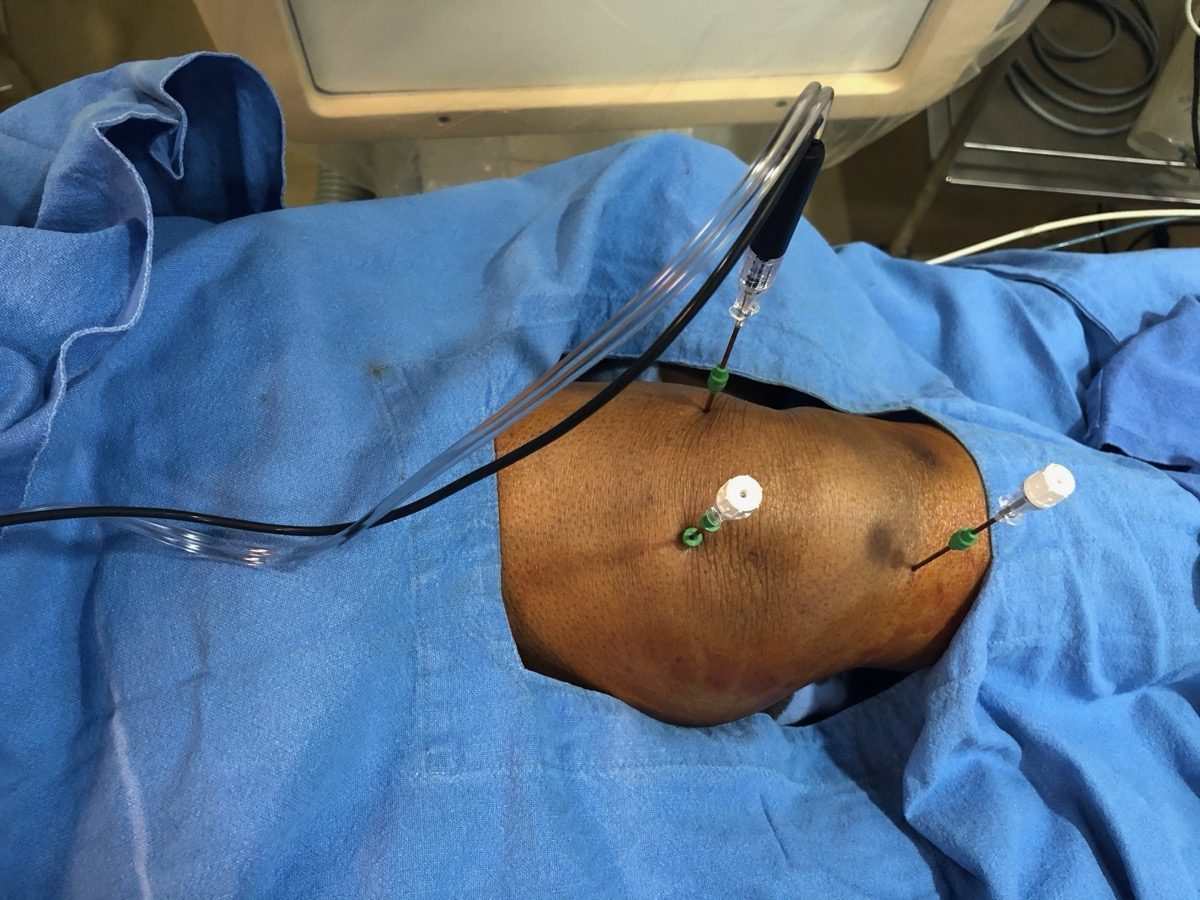
You lie on your back on the fluoroscopy table. The knee area is cleaned and draped. Under live X-ray guidance, three cooled RF probes are positioned at the standard genicular nerve landmarks: the SM probe at the junction of the femur shaft and medial condyle, the SL probe at the junction of the femur shaft and lateral condyle, and the IM probe at the junction of the tibial shaft and medial condyle. Local anaesthetic is given at each site. The cooled RF generator then applies energy to each probe sequentially. The procedure takes approximately 60-90 minutes.
When will I feel better after Knee Joint Cooled RFA?
Expect mild soreness around the knee for 1–2 weeks. This is the normal tissue response to heat. Pain relief begins to build from 2–4 weeks as the ablated nerve fibres stop transmitting pain. Full benefit is usually seen at 4–8 weeks. Most patients are able to increase their walking distance and daily activity progressively during this period.
How long does pain relief last after Knee Joint Cooled RFA?
Clinical studies report pain relief lasting 12 months or more in the majority of patients. Some patients have reported sustained relief at 2+ years. The genicular nerves can regenerate over time, but repeat procedures are safe and well-tolerated. Cooled RFA consistently outperforms conventional RFA and single steroid injections in published comparative studies for knee osteoarthritis.
Can I have Knee Cooled RFA if I already have a knee replacement?
Yes. Persistent pain after total knee arthroplasty (TKA) affects 10–20% of patients, and the genicular nerves can continue to carry pain from the joint capsule even after the joint surfaces have been replaced. Cooled RFA of the genicular nerves is an established option for post-TKA pain, with good success rates reported in this patient group. The metal implant does not interfere with fluoroscopic guidance or the ablation.