
Shoulder Joint RFA & Frozen Shoulder Release
Chronic shoulder pain and stiffness can stop you from reaching, lifting, or sleeping properly. Our targeted approach (nerve RFA for lasting pain relief and hydrodistension for frozen shoulder) addresses both problems at the source.
Your journey
Your Road to a Pain-Free Life
Before Your Visit
What to do before coming in.
Key Points
Stop blood thinners 3–7 days before (as advised)
Bring shoulder MRI, ultrasound, or X-ray reports
Arrange a driver home
Wear loose clothing that allows easy shoulder access
For females: please remove all jewellery, nail polish, nail caps, and makeup before the procedure
What to Expect
The team reviews your history and imaging to decide whether RFA, hydrodistension, or both is the right plan for you.

Patient is relaxed and ready for the procedure
← Swipe to explore stages →
Before Your Visit
What to do before coming in.
Key Points
Stop blood thinners 3–7 days before (as advised)
Bring shoulder MRI, ultrasound, or X-ray reports
Arrange a driver home
Wear loose clothing that allows easy shoulder access
For females: please remove all jewellery, nail polish, nail caps, and makeup before the procedure
What to Expect
The team reviews your history and imaging to decide whether RFA, hydrodistension, or both is the right plan for you.
Test your knowledge
How Well Do You Know This Procedure?
Which nerves are targeted in Shoulder Joint RFA?
Frequently asked questions
What is Shoulder Joint RFA?
Shoulder Joint RFA uses radiofrequency energy to ablate the articular (sensory) branches of the suprascapular nerve and the posterior branch of the axillary nerve. These are the main nerves carrying pain signals from the shoulder joint. Ablating them significantly reduces shoulder pain due to osteoarthritis, rotator cuff disease, or post-surgical pain, with relief lasting 12–18 months or more.
What is Frozen Shoulder Release?
Frozen shoulder (adhesive capsulitis) happens when the capsule surrounding the shoulder joint thickens and tightens, severely restricting movement. Frozen Shoulder Release (also called hydrodilatation or hydrodistension) is an image-guided procedure where a large volume of saline mixed with a steroid and local anaesthetic is injected into the joint under pressure. This stretches and breaks the adhesive capsule, restoring movement and relieving pain.
Who needs Shoulder Joint RFA or Frozen Shoulder Release?
Shoulder Joint RFA is for patients with chronic shoulder pain from arthritis, rotator cuff disease, or post-surgical shoulder stiffness, where pain persists despite physiotherapy and injections. Frozen Shoulder Release is for patients with adhesive capsulitis who have significantly restricted shoulder movement. When a frozen shoulder also comes with significant pain, both procedures may be done together in the same session.
Can Shoulder Joint RFA and Frozen Shoulder Release be done together?
They can be. In many frozen shoulder patients with significant pain, the RFA is done first (to reduce pain) and the hydrodistension is done in the same or a closely following session (to restore movement). Your assessment will determine which procedure (or which combination) is right for you.
How are Shoulder Joint RFA and Frozen Shoulder Release performed?
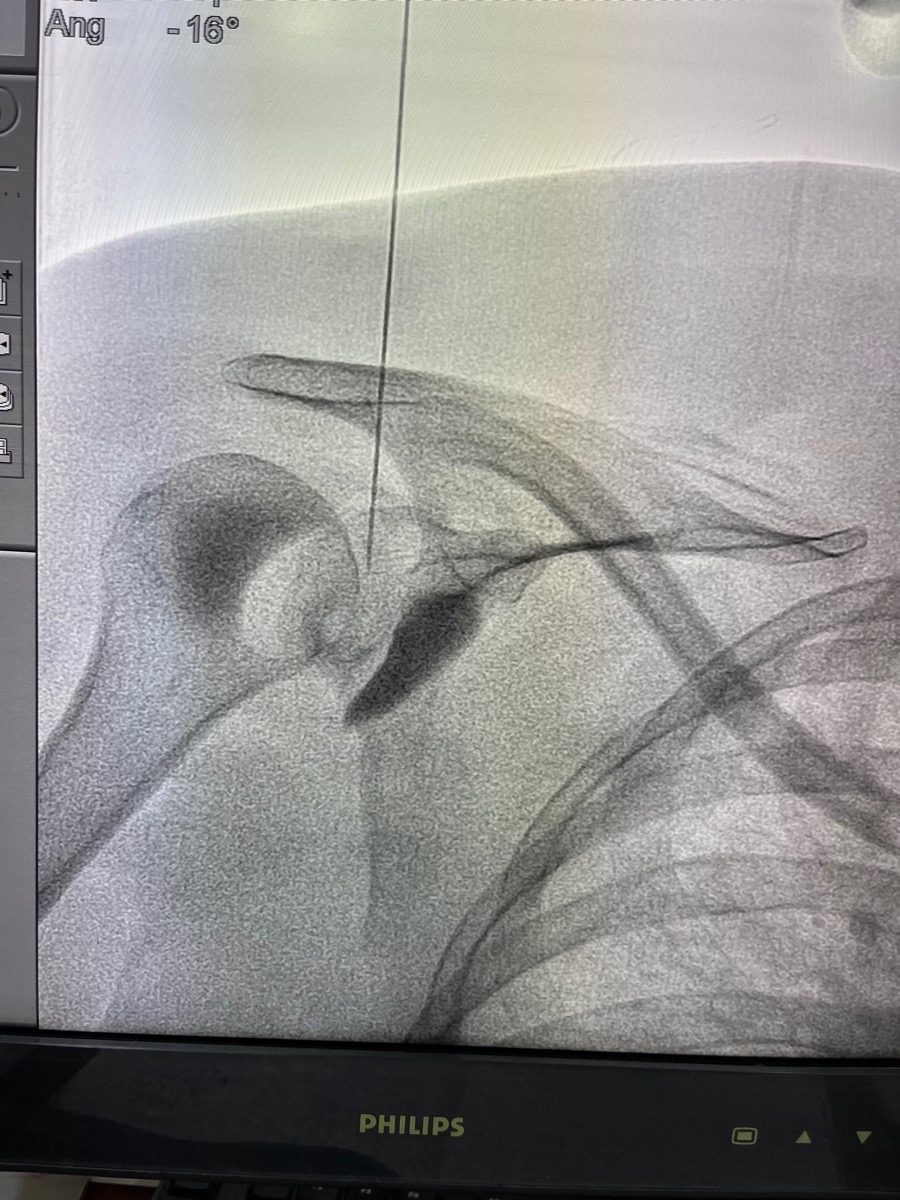
RFA: You sit or lie on your side. The procedure can be done under ultrasound or fluoroscopic guidance. RF probes are placed at the articular branches of the suprascapular and axillary nerves. A sensory stimulation test confirms positioning, then RF energy is applied to each probe site. Takes about 20–30 minutes.
Frozen Shoulder Release: Under ultrasound guidance, a needle is placed into the glenohumeral joint through the posterior approach. A 20–40 ml solution of saline, steroid, and local anaesthetic is injected slowly under pressure. You hear or feel a "give" as the capsule distends, this signals a successful release. Takes about 15–20 minutes.
When will I feel relief after Shoulder Joint RFA or Frozen Shoulder Release?
After hydrodistension, movement often improves within days (especially if physiotherapy is started promptly. After RFA, pain reduction builds over 2–4 weeks as the ablated nerve fibres stop transmitting pain. Some patients notice a combination of both) improved mobility and reduced pain, within the first 2–3 weeks.
Can I go home the same day?
Yes. Both procedures are done on a day-care basis. You rest for 2–4 hours after the procedure, then go home. Arrange a driver for the day. Most patients start gentle shoulder physiotherapy exercises within 48–72 hours.