
 Jain Pain Clinic
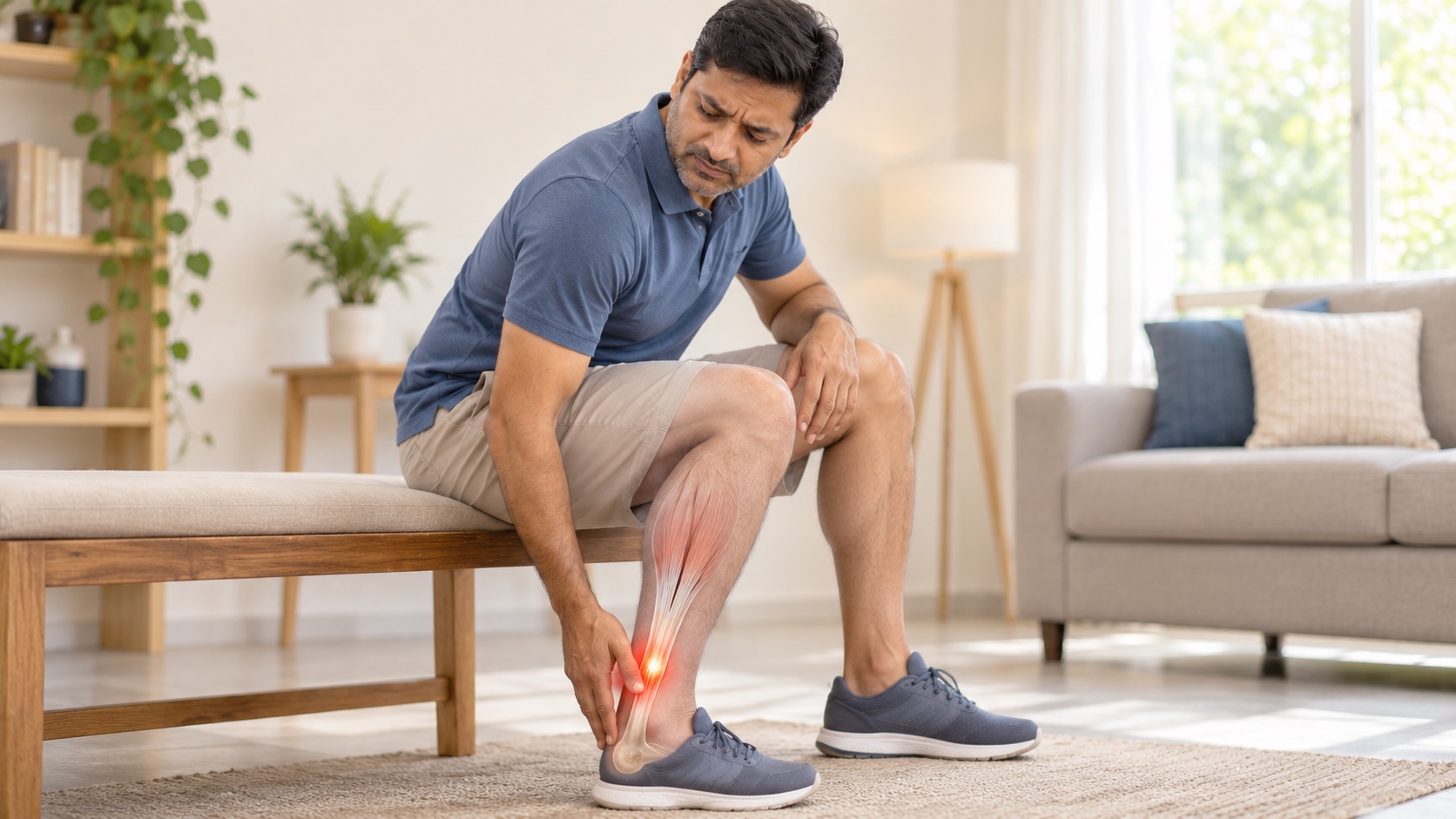
The back of your ankle feels stiff with the first steps of the day. It eases as you move, then aches after a longer walk or run. Achilles tendinopathy is one possible cause. It can affect active people and those who do not play sport. Treatment usually involves understanding the tendon’s current tolerance and gradually rebuilding capacity. Sudden pain with a snap or loss of push-off is a different situation and needs prompt assessment.
On this page
Where Is the Achilles Tendon, and What Is Tendinopathy?
The Achilles tendon connects the calf muscles to the heel bone and helps you push off when walking, running or climbing stairs. Tendinopathy describes tendon pain and impaired function associated with loading. It is not simply a synonym for an acute tear.
Pain can occur at the insertion into the heel bone or in the midportion, higher above the attachment. The distinction matters because a movement that is useful for one pattern can compress and aggravate the other.
Common Symptoms and Changes in Load
Symptoms may include morning stiffness, tenderness behind the ankle, thickening of the tendon and pain during or after activity. Some people feel better once warmed up but become more uncomfortable later or the next morning.
A change in walking distance, hills, running, jumping or footwear can be relevant. Tell your clinician about the weeks before symptoms began, including a return to activity after time off. Sometimes there is no single obvious trigger.
Pain under the heel is a different location. Our existing plantar heel-pain article covers that pattern; do not assume the same exercise or injection plan fits both.
A Sudden Snap or Loss of Push-Off Needs Assessment
A rupture can feel like a sudden kick to the back of the leg, sometimes with a pop or snap. Difficulty pushing off, walking normally or rising onto the toes after a sudden injury needs prompt medical assessment. Do not repeatedly test a painful heel raise to reassure yourself.
Some movement may still be possible after a rupture. Being able to move the ankle does not reliably exclude it. Avoid treating a new acute injury as a familiar tendinopathy flare until it has been checked.
A hot, rapidly swollen area, fever or marked calf swelling also deserves assessment for other causes rather than automatic treatment as tendon pain.
How Is Achilles Tendinopathy Assessed?
The clinician checks the location, symptom behaviour, tendon and calf function and the effect on walking. Ultrasound or MRI may help when a tear or a different diagnosis is suspected, or when imaging would change management. A scan is not obligatory for every typical case.
Bring your usual footwear and a description of activity, including the point at which symptoms appear. A thickened tendon on an old scan does not alone explain a new loss of strength. Explain any recent injury separately.
Progressive Loading Is a Main Part of Treatment
The 2024 clinical practice guideline for midportion Achilles tendinopathy recommends tendon-loading exercise as first-line care for suitable patients. This means gradually challenging the tendon within tolerance rather than either stopping all activity indefinitely or exercising through escalating pain.
A therapist may use controlled calf raises and adjust the starting position, resistance, speed and frequency. The programme should reflect your current ability and any other health problems. A seated or supported starting exercise may be more realistic than a single-leg exercise immediately.
Agree how to judge the response during the session and the following day. A programme that repeatedly worsens walking or morning symptoms needs adjustment. The goal is a repeatable amount from which you can progress.
Insertional Pain: Why Heel Drops Off a Step May Be Wrong
When pain is at the attachment to the heel bone, lowering the heel below the level of a step can increase compression at the insertion. Exercises may need to begin on a flat surface with a controlled range. Do not copy a step-based routine without checking which tendon region is affected.
The AAOS Achilles tendinitis guide distinguishes insertional and non-insertional care. A clinician can also review whether a temporary heel lift or footwear adjustment is appropriate.
More stretching is not automatically better. Avoid forceful calf stretches or repeated deep ankle bending that aggravates insertional symptoms. Equipment and exercise choices should serve the diagnosis, not the other way around.
What Can You Change in Daily Life?
Adjust the activity that repeatedly exceeds tolerance while maintaining comfortable alternatives. Shorter, flatter walks or another suitable form of exercise may help preserve fitness. Review footwear pressure at the back of the heel and avoid abrupt changes in shoe type.
Suitable pain relief may ease symptoms, but check it against your health and other medicines. It should not become a way to push through a load the tendon cannot currently tolerate.
- Record morning stiffness and the response the day after exercise.
- Consider the combined load from work, walking, stairs and training.
- Increase one part of the programme at a time when advised.
- Report new loss of strength or a sudden change in symptoms promptly.
Do PRP, Steroid Injections or Shockwave Heal the Tendon?
Injection decisions need evidence for the particular condition. Corticosteroid injection into the Achilles tendon is generally avoided because of rupture risk. Do not assume that a treatment used for another tendon has the same benefit or safety here.
A 2021 randomised trial of PRP for chronic midportion Achilles tendinopathy included 240 participants. A single PRP injection did not improve tendon-related dysfunction at six months compared with a sham procedure. This finding applies to that condition and protocol; it does not establish a universal effect for every platelet preparation or tendon disorder.
Shockwave or other specialist options may be discussed for persistent symptoms, but response varies. Ask what the proposed treatment adds to an adequately supported loading programme and what outcome would justify its cost and risks.
Recovery, Surgical Review and Your Next Appointment
Improvement often takes months, and returning to high-demand activity may take longer than comfortable everyday walking. Review the trend in function rather than expecting the tendon to look normal on a scan or relying only on pain during a warm-up.
Surgery may be considered in selected persistent cases after suitable non-surgical treatment and reassessment. A pain score alone is not the indication; location, structural findings, function and personal goals matter.
For a Jain Pain Clinic consultation, bring the timeline, previous treatment and activity goals. Ask for a plan that distinguishes symptom relief from rehabilitation and includes a clear review point. A new snap, major weakness or inability to walk needs urgent care rather than waiting for a routine follow-up.
Resources
- Achilles tendinitis: insertional and non-insertional careAAOS OrthoInfo
- A patient guide to Achilles tendinopathyRoyal National Orthopaedic Hospital
- Midportion Achilles tendinopathy: clinical practice guidelineJournal of Orthopaedic & Sports Physical Therapy, 2024
- Achilles tendinopathy: diagnosis and rehabilitationGuy’s and St Thomas’ NHS Foundation Trust
- PRP versus sham injection: randomised clinical trialJAMA, 2021
- Insertional Achilles tendinopathy: compression and footwearKent Community Health NHS Foundation Trust
- Achilles tendinopathy: exercise and step precautionsGeorge Eliot Hospital
Frequently asked questions
Is Achilles pain the same as plantar fasciitis?
No. Achilles pain is behind the heel or ankle, while plantar fascia pain is usually under the heel. Location and examination guide treatment.
Can a tendon rupture happen even if I can move my ankle?
Yes. Some movement may remain. A sudden pop, loss of push-off or difficulty walking after injury needs prompt assessment.
Should everyone do heel drops off a step?
No. Lowering below step level can aggravate insertional symptoms. Have the affected region and suitable exercise range checked.
Should I stop every form of exercise?
Not automatically. Adjust aggravating activity and discuss suitable alternatives while following an individual loading programme.
Does PRP reliably cure Achilles tendinopathy?
That is not established. A trial of a single PRP injection for chronic midportion tendinopathy found no functional benefit over sham at six months.
How should I judge whether treatment is working?
Track morning symptoms, comfortable walking and a relevant activity. Review progress and any next-day worsening with your clinician.