
 Jain Pain Clinic
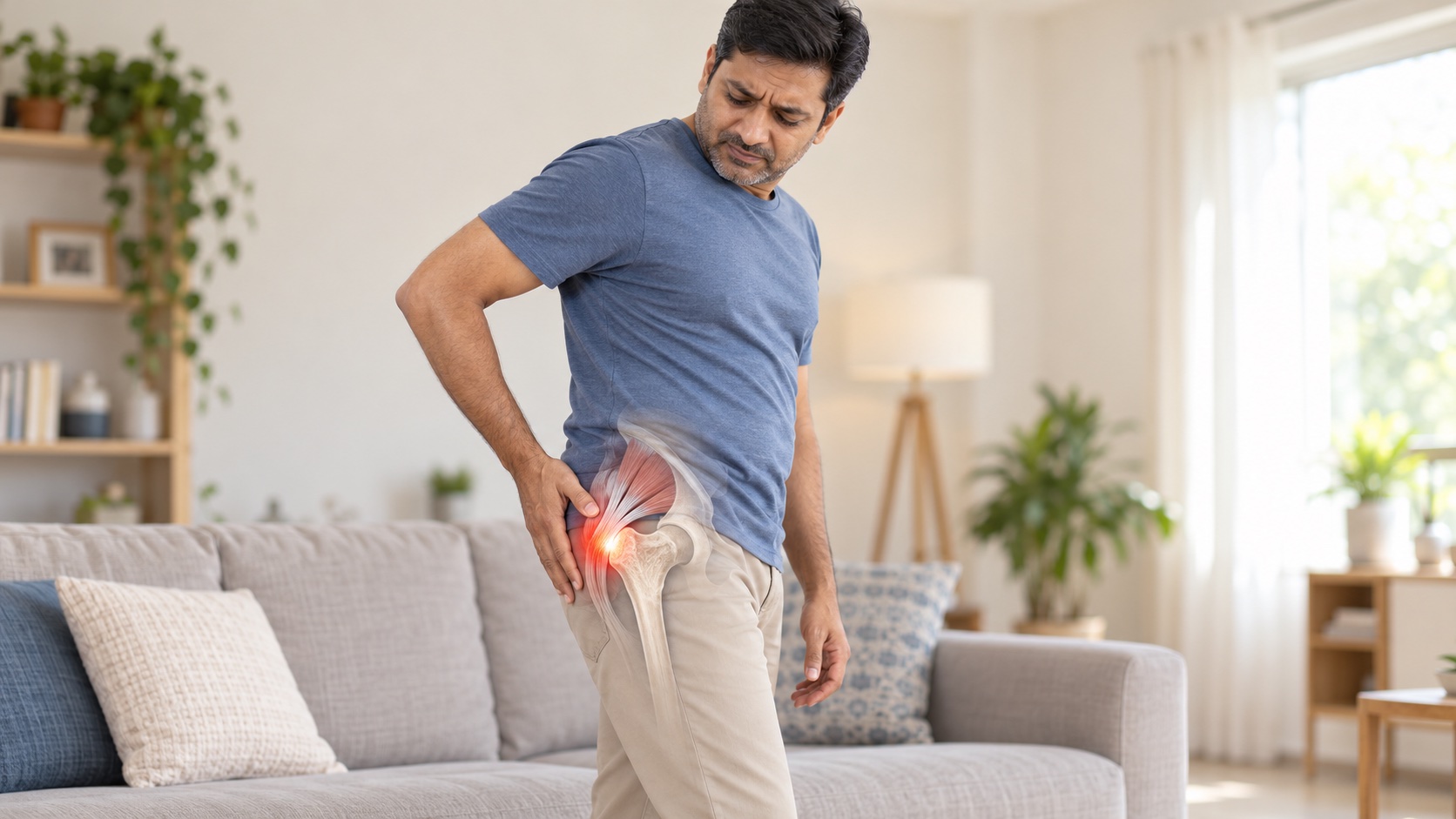
You turn onto your side in bed and a familiar ache returns over the outside of the hip. Stairs have become uncomfortable, and standing with your weight on that leg makes it worse. This pattern can occur with greater trochanteric pain syndrome, or GTPS. It is often called hip bursitis, but the gluteal tendons may be an important part of the problem. The right next step is to identify the source, reduce aggravating pressure and rebuild useful strength—not simply choose a stronger painkiller.
On this page
What Is Greater Trochanteric Pain Syndrome?
The greater trochanter is the bony prominence on the outer upper part of the thigh bone. Tendons from the gluteus medius and minimus muscles attach around it and help control the pelvis when you walk or stand on one leg. Small fluid-filled sacs called bursae help nearby tissues glide.
GTPS is an umbrella term for pain arising around these outer-hip tissues. Gluteal tendinopathy describes a problem involving the tendons. Trochanteric bursitis refers to the bursa. They may coexist, so describing every case as inflammation in a small sac can miss an important contributor.
A tender spot on the side does not establish the diagnosis by itself. A clinician checks whether the location, movements and other findings fit together before recommending treatment.
Why Does Lying on Your Side Make It Worse?
Lying directly on a sensitive hip applies pressure to the tissues over the greater trochanter. Positions that allow the upper leg to fall across the body can also increase compression around the outer hip. This helps explain why some people hurt even when lying on the opposite side.
Compare positions rather than repeatedly pressing the tender area. Does lying on your back help? Does supporting the upper leg reduce discomfort? Record whether pain wakes you only after rolling onto the hip or remains severe regardless of position. That distinction is useful at assessment.
Common Symptoms and Changes in Activity
Pain is usually concentrated on the outer hip and can extend along the outer thigh or towards the buttock. It may be aggravated by walking, hills, stairs, standing on one leg or getting out of a low chair. Direct tenderness is common. Symptoms can develop gradually without a fall.
A recent change in demand can matter: longer walking distances, a hilly holiday, more running or returning to activity after time off. Tell your clinician what changed in the weeks before symptoms began. The aim is to understand the current load, not assume that every painful step is causing fresh damage.
- Note which side is painful and point to the main location.
- Describe what happens during stairs, walking and sleep.
- Mention a fall, new limp, sudden weakness or difficulty bearing weight.
- Bring previous hip and spine reports, but explain the current symptoms in your own words.
How Is It Different From Hip Arthritis or Sciatica?
Pain deep in the groin, restricted hip movement and difficulty with shoes or socks can suggest a problem within the joint, including arthritis. Pain travelling from the back into the leg with tingling or numbness raises a different question about nerves. These patterns are clues, and more than one condition can be present.
Our guide to recurring groin pain discusses a different location. If your main symptom is leg tingling, say so rather than assuming it belongs to the outer-hip diagnosis.
An examination may check hip motion, walking, local tenderness, strength and the lower back. Avoid repeatedly trying painful one-leg tests at home to prove which condition you have. A finding is useful only in the context of the full assessment.
Do You Need an Ultrasound or MRI?
Many cases are assessed clinically. Imaging becomes more useful when symptoms are atypical, a significant tendon tear or another diagnosis is suspected, or appropriate treatment has not helped. An X-ray addresses different questions from ultrasound or MRI.
Ask what a proposed scan will change: will it check the joint, investigate an injury or guide a specific treatment? Tendon and bursal changes on imaging must be interpreted alongside the examination. A scan label alone does not tell you how much you can walk or whether an injection will help.
If pain follows a fall and weight-bearing is difficult, the priority is prompt assessment for injury rather than arranging a routine rehabilitation scan.
Sleeping, Sitting and Standing With Less Pressure
If comfortable, sleep on your back with support under the knees. When lying on the less painful side, a pillow between the legs can keep the upper leg from dropping across the body. Choose enough support for comfortable alignment rather than forcing a particular position.
Avoid prolonged crossed-leg sitting and repeatedly hanging your body weight over one hip. A slightly higher, supportive chair may be more comfortable than a low seat. Change positions during the day; there is no need to hold a rigid posture.
The Cambridge University Hospitals gluteal tendinopathy guide explains ways to reduce tendon compression. Try one practical change at a time so you can judge its effect on sleep or a daily task. Buying a new mattress is not automatically the first solution.
Walking and Exercise: Build Capacity Without Repeated Flares
An individual programme usually combines advice about load with progressive hip-muscle strengthening. This means matching what you do to current tolerance, then building capacity. It does not mean stopping all movement indefinitely or pushing through a worsening limp.
For example, if one long walk consistently causes a bad night, shorter, flatter walks may be a workable starting point. Consider the combined demand from walks, stairs, standing and exercises. Adding strengthening on top of an already excessive day may need adjustment.
The NHS inform exercise guide for GTPS includes bridging, supported side-lying leg lifts and step work for diagnosed cases. Your physiotherapist can choose suitable movements and loading. Symptoms should not be worse overall or worse the following morning.
If an exercise increases pain, reduce its load, range or amount and discuss the response. Do not assume that aggressive stretching across the body or repeatedly rolling directly over the painful outer hip will improve a tendon problem.
What Does Research Say About Exercise Versus Steroid Injection?
A 2018 randomised trial of gluteal tendinopathy compared education plus exercise, one corticosteroid injection and a wait-and-see approach in 204 adults. The exercise group received a structured eight-week programme rather than a generic exercise handout.
At eight weeks, education plus exercise produced better patient-reported improvement and pain outcomes than injection. At 52 weeks, more people in the education-and-exercise group reported overall improvement than in the injection group, but pain intensity was not significantly different between those two groups.
This distinction matters: the trial supports a structured rehabilitation approach, but it does not prove that every exercise programme works or that every injection is inappropriate. Participants had clinically and MRI-confirmed gluteal tendinopathy; the findings should not be applied to every cause of hip pain.
When Might Medicines, Injections or Other Procedures Be Considered?
Suitable pain relief may help you sleep or participate in rehabilitation. Check the choice with a pharmacist or clinician, particularly with stomach ulcers, kidney disease, pregnancy or blood-thinning medicines. Symptom relief does not replace identifying the source and adjusting demand.
A corticosteroid injection may offer short-term relief for selected patients. Ask where the medicine would be placed, what risks apply, whether guidance is needed and what happens after the temporary benefit fades. Repeating an injection simply because the pain returns needs a fresh discussion.
For persistent symptoms, a specialist may discuss other options or reassess for a tear or a different source. Ask what evidence supports the proposed procedure compared with a well-supported rehabilitation programme. A claim of permanent tendon regeneration deserves scrutiny.
Surgery is uncommon and requires a specific indication. A tendon tear on a scan does not automatically make surgery necessary; symptoms, function and response to treatment also matter.
How Long Does Recovery Take, and How Should You Track It?
Outer-hip tendon symptoms can take months to settle, and progress is not always a straight line. A flare after an unusually busy day does not by itself prove that rehabilitation has failed. Increasing disability or a new pattern of pain, however, should prompt reassessment.
Choose two useful measures: nights disturbed by hip pain and the walking or stair task you can manage. Review the trend at an agreed interval. If progress has stalled, discuss exercise technique, total activity, sleep position, adherence barriers and whether the original diagnosis still fits.
When Should You Seek Prompt Medical Assessment?
Arrange a review if hip pain disrupts sleep or normal activity, worsens or keeps recurring. Seek urgent care for severe sudden pain, a hot or swollen hip with fever, or severe symptoms after a fall. Inability to walk or bear weight needs urgent assessment rather than treatment as routine bursitis.
If a new symptom is clearly different from your usual outer-hip pain, explain it separately. At a Jain Pain Clinic consultation, bring the timeline and previous treatment, and identify the activity you most want to regain. A useful plan should give each treatment a purpose and include a review point.
Resources
- Greater trochanteric pain syndrome: symptoms and self-managementNHS inform
- Gluteal tendinopathy: tendon compression and positioningCambridge University Hospitals
- Exercises for greater trochanteric pain syndromeNHS inform
- Education plus exercise versus corticosteroid injection: randomised trialBMJ, 2018
- Hip bursitis: assessment and treatment optionsAAOS OrthoInfo
- A patient guide to gluteal tendinopathyRoyal National Orthopaedic Hospital
- Hip pain: when to get urgent helpNHS
Frequently asked questions
Why does my hip hurt when I lie on my side?
Direct pressure can aggravate the tendons and bursa around the outer hip. GTPS is one possibility, but an examination is needed to distinguish it from joint, nerve or injury-related pain.
Is gluteal tendinopathy the same as hip bursitis?
They describe different tissues. Tendinopathy involves the tendon, while bursitis involves a nearby fluid-filled sac. They can coexist within greater trochanteric pain syndrome.
Should I stop walking if I have outer hip pain?
Adjust the distance, pace or terrain to what you can tolerate and seek advice if you limp or worsen. Sudden severe pain or inability to bear weight needs urgent assessment.
Can a pillow help hip pain at night?
Some people find that lying on the less painful side with a pillow between the legs reduces compression. Lying on the back with knee support is another option when comfortable.
Is a steroid injection better than exercise?
It depends on the diagnosis and goal. In a trial of gluteal tendinopathy, a structured education-and-exercise programme had better overall improvement than a single injection at one year, although pain intensity was similar.
Do I need surgery if a scan shows a tendon tear?
Not automatically. A specialist considers the examination, degree of weakness, function and response to suitable rehabilitation alongside imaging.