
 Dr Ashu Kumar Jain
Knee pain treatment usually starts with identifying the cause, adapting aggravating activity and building an appropriate exercise plan. Medicines, injections or specialist procedures may help selected problems; some injuries or advanced arthritis need a surgical opinion. The location, onset, swelling and effect on walking guide the next step. A hot swollen knee, major injury, inability to bear weight or a knee that remains locked needs prompt medical care.
On this page
How Is Treatment for Knee Pain Chosen?
No single knee pain treatment suits everyone. Treatment should be selected after assessing the location of pain, duration of symptoms, swelling, movement, walking pattern, previous injuries, medical conditions, and response to earlier treatment.
For mild or recent knee pain, treatment may include activity modification, physiotherapy, appropriate exercises, ice or heat when suitable, and short-term medicines prescribed by a doctor.
For chronic knee pain that continues despite medicines and rehabilitation, a pain specialist may consider targeted injections, diagnostic nerve blocks, or procedures such as genicular nerve radiofrequency ablation in carefully selected patients.
Find the Guide That Matches Your Question
Different symptoms lead to different decisions. These guides explain common questions without assuming that every painful knee has the same cause.
Common Causes of Knee Pain
Knee pain can start suddenly after an injury or develop gradually over months or years. The same symptom, such as pain while walking, may come from different conditions.
Common causes include osteoarthritis, meniscus irritation or tears, ligament injuries, patellofemoral pain, tendon problems, bursitis, gout, inflammatory arthritis, referred pain from the hip or lower back, and nerve-related pain around the knee.
An X-ray or MRI may show structural changes, but the scan alone does not always explain how severe the pain feels. The examination and symptom pattern are also important.
- Knee osteoarthritis and cartilage wear
- Meniscus injury or irritation
- Ligament and tendon injuries
- Pain around the kneecap
- Inflammation, bursitis, or gout
- Nerve-related pain or sensitised nerves
- Referred pain from the hip or lower back
- Pain after previous knee surgery
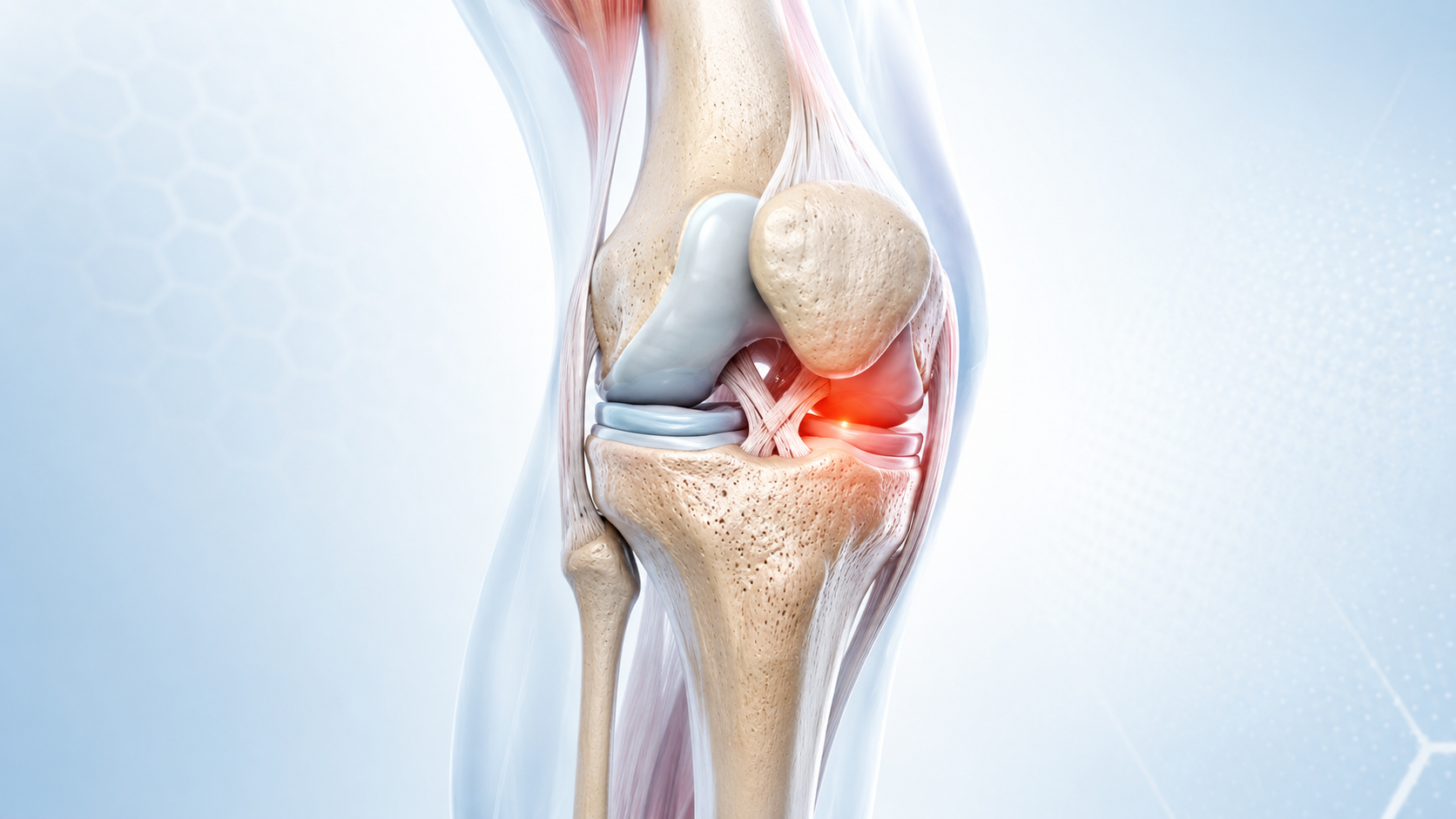
What Does the Location of Knee Pain Suggest?
Front-of-knee pain with stairs, squats or prolonged sitting may involve the kneecap joint or nearby tendons. Pain along the inner or outer joint line may occur with arthritis or meniscal problems. A local tender swelling over the kneecap can involve a bursa. Pain at the back raises questions about a cyst, muscle or tendon, as well as less common nerve or circulation problems.
Location narrows the examination, but it does not select a treatment by itself. An inner-knee pain map cannot reliably distinguish arthritis from a tear, and a lump behind the knee should not automatically be labelled a Baker’s cyst. Tell the clinician where the pain begins, where it travels and which movement reproduces it.
Use the focused guides on arthritis versus meniscus tears and pain behind the knee when those patterns match your question. They explain the limits of self-diagnosis and what an assessment may need to establish.
Why Can a Knee Hurt Without an Injury?
Not every painful knee starts with a fall or sports accident. Symptoms can develop after a gradual increase in walking, repeated kneeling, a new exercise routine or changes within an arthritic joint. Crystal inflammation and inflammatory arthritis can also occur without a remembered injury.
Look for a change in demands as well as a single event. A new commute with more stairs, a return to running after inactivity or repeated floor-level work may matter even if nothing “went wrong” at the time. This helps a clinician decide whether activity adaptation is a reasonable starting point.
A sudden hot swollen knee is different from a gradual activity-related ache. Do not use “no injury” as a reason to assume nothing important is happening. The swelling, warmth, severity and associated illness may determine the urgency more than the presence or absence of trauma.
Does Knee Pain at Night Mean Severe Arthritis?
Night pain can occur with arthritis or other painful conditions, but the timing alone does not identify the cause or its severity. Note whether it follows a particularly active day, changes with position or remains constant regardless of movement. Also mention swelling, fever, unexplained weight loss or pain in other areas.
Persistent sleep disruption deserves assessment because it affects function and recovery, even if the scan has been described as mild. Conversely, a severe-looking X-ray does not tell the clinician exactly how often pain wakes you. Both the symptoms and the imaging need to be considered.
Use concrete descriptions at the appointment: whether you wake once or repeatedly, whether changing position helps, and how the next day is affected. Avoid independently adding sedating medicines simply to sleep through unexplained pain.
How Knee Pain Is Diagnosed
A knee pain doctor usually begins by asking when the pain started, where it is located, what makes it worse, and whether there is swelling, locking, clicking, numbness, or weakness.
The examination may include knee movement, muscle strength, alignment, walking pattern, hip function, lower-back symptoms, and signs of nerve involvement. This helps determine whether the pain is coming mainly from the joint, surrounding tissues, or a nerve.
X-rays may help assess arthritis and alignment. Ultrasound can be useful for selected soft-tissue problems and image-guided procedures. MRI may be considered when there is concern about a meniscus, ligament, cartilage, or other internal knee problem.
A scan should support the clinical assessment rather than replace it. Many structural changes are common with age and may not be the main reason for pain.
When Will a Scan Actually Change Treatment?
NICE explains that typical osteoarthritis can often be diagnosed clinically and that imaging is not routinely needed unless there are atypical features or another concern. That guidance is specific to osteoarthritis; a significant new injury or unexplained swelling can require a different approach.
Before another scan, ask which decision depends on it. An X-ray may address arthritis, alignment or a bone injury. Ultrasound may help with fluid or selected superficial tissues. MRI may answer an internal soft-tissue question. A blood test or joint-fluid sample may be more relevant when inflammation or infection is suspected.
Bring previous images and reports, not only the latest conclusion. If symptoms have changed, explain how. A new test is most useful when it addresses an unresolved question, rather than simply repeating a picture because pain has not yet settled.
Knee Pain Treatment at Home
For mild knee pain without warning signs, short-term self-care may help reduce irritation while you arrange an assessment.
Reduce activities that clearly worsen pain, but avoid complete rest for long periods. Gentle movement can help prevent stiffness. Use a stable support if walking feels unsafe and return to activity gradually.
Do not continue an exercise that causes sharp pain, increasing swelling, repeated locking, or a feeling that the knee is giving way.
- Use relative rest instead of complete inactivity
- Try gentle range-of-motion exercises if they are comfortable
- Avoid sudden increases in walking, running, or stair climbing
- Use ice or heat according to professional advice and personal tolerance
- Wear comfortable footwear and use support when balance is uncertain
- Do not take pain medicines for long periods without medical advice
Exercise and Physiotherapy for Knee Pain
Physiotherapy is an important part of knee pain treatment for many conditions. A programme may focus on knee movement, quadriceps strength, hamstring flexibility, hip control, balance, and walking mechanics.
Common exercises include heel slides, quadriceps contractions, straight-leg raises, seated knee extensions, calf stretches, supported sit-to-stand movements, and gradual strengthening with resistance.
The exercises should match the diagnosis. Deep squats, jumping, running, and heavy resistance may aggravate symptoms if introduced during a painful flare or before the knee is ready.
Read our guide to knee pain exercises and stretches for a detailed explanation of safe movement and warning signs.
Medicines for Knee Pain
Medicines may reduce pain or inflammation, but they do not treat every cause of knee pain. The choice depends on your age, kidney and liver health, stomach problems, blood pressure, other medicines, and the suspected diagnosis.
A doctor may consider topical medicines, paracetamol, anti-inflammatory medicines, or other options when appropriate. These medicines should not be continued routinely without reviewing whether they are helping and whether side effects are developing.
If pain remains severe despite medicines, repeatedly increasing the dose is not always the safest or most effective next step. A specialist assessment may identify a more targeted treatment.
Compare knee pain medicines before relying on repeated tablets.
Injections for Knee Pain
Injections may be considered when pain is persistent, limiting function, or not responding adequately to rehabilitation and medicines. The type of injection depends on the suspected pain source.
A corticosteroid injection may provide short-term relief for selected inflammatory conditions or arthritis flares. Other injections, such as hyaluronic acid or platelet-rich plasma, may be discussed in selected situations, but results vary between patients and conditions.
An injection should not be recommended only because an X-ray shows arthritis. The expected benefit, risks, alternatives, and treatment goal should be explained before proceeding.
Read the steroid, hyaluronic acid and PRP comparison for evidence, risks and questions to ask.
- Intra-articular knee injections for selected joint-related pain
- Image-guided injections for specific soft-tissue problems
- Diagnostic injections to identify a suspected pain source
- Genicular nerve blocks for selected chronic knee pain
- Follow-up rehabilitation to maintain improvement after pain relief
Genicular Nerve Block for Chronic Knee Pain
Some patients continue to experience significant knee pain even after physiotherapy, medicines, and joint injections. In these cases, the genicular nerves may be contributing to the pain signals from the knee.
A genicular nerve block places local anaesthetic near selected sensory nerves supplying the knee. It may be used as a diagnostic procedure to see whether reducing signals from these nerves also reduces the patient's typical pain.
A positive response does not mean that the underlying arthritis has disappeared. It helps the pain specialist decide whether a nerve-focused treatment may be appropriate.
Cooled Radiofrequency Ablation for Selected Knee Pain
When chronic knee pain is confirmed to have a significant genicular nerve component and temporary nerve blocks provide meaningful relief, cooled radiofrequency ablation may be considered for selected patients.
The procedure uses controlled radiofrequency energy to reduce pain signalling from targeted sensory nerves. It does not repair cartilage or reverse arthritis. Its purpose is to provide longer-lasting pain relief and improve function when other suitable treatments have not provided enough benefit.
The decision depends on the diagnosis, previous treatment, response to diagnostic blocks, general health, and the patient's goals. It is not suitable for every person with knee arthritis.
The cooled RFA procedure guide explains the procedure in more detail.
- The diagnosis should be clear
- The main pain source should be assessed clinically
- Conservative treatment should have been considered
- A diagnostic nerve block may be used before ablation
- Risks and expected benefits should be discussed
- Rehabilitation and activity planning remain important after treatment

Can Knee Pain Be Treated Without Surgery?
Many people can manage knee pain for a long time with a combination of exercise, physiotherapy, activity changes, medicines, injections, and targeted pain procedures. The possibility of avoiding or delaying surgery depends on the severity and cause of the problem.
Non-surgical treatment does not mean ignoring severe structural damage or postponing necessary care. It means understanding the available options before making a decision.
For more information, read our article on non-surgical knee pain treatment .
When Is Knee Surgery Considered?
Surgery may be considered when there is a significant structural problem, severe deformity, major injury, persistent mechanical symptoms, or pain and disability that continue despite appropriate non-surgical treatment.
A knee replacement may help selected patients with advanced arthritis and substantial loss of function. It is not automatically required because an X-ray shows cartilage loss, and it is not the correct treatment for every type of knee pain.
A surgical opinion and a pain-medicine opinion can sometimes provide different but complementary information. The decision should consider pain severity, mobility, medical fitness, functional goals, previous treatment, and expected recovery.
When Should You See a Knee Pain Doctor?
You should arrange an evaluation if knee pain lasts more than a few weeks, keeps returning, affects sleep, limits walking, makes stairs difficult, or does not improve with basic treatment.
You may benefit from seeing a knee pain specialist in NCR when pain persists despite physiotherapy and medicines, when you have been advised to consider surgery, or when the scan findings do not match the severity or location of your symptoms.
At Jain Pain Clinic in Gurugram, Dr Ashu Kumar Jain assesses whether the pain is coming from the knee joint, surrounding tissues, nerves, hip, or lower back before discussing treatment options.
Warning Signs That Need Urgent Medical Care
Seek urgent medical attention after a major injury, if the knee looks deformed, or if you cannot bear weight. Sudden severe swelling may also need prompt assessment.
A hot, red, swollen knee with fever or feeling unwell should not be treated only with home remedies. These symptoms may indicate infection or another urgent inflammatory problem.
Urgent assessment is also important if the knee repeatedly locks, suddenly gives way, or pain is associated with new weakness or numbness.
- Knee deformity after an injury
- Inability to bear weight
- Sudden severe swelling
- Fever with a hot or red knee
- A knee that locks completely
- Sudden weakness or loss of sensation
- Rapidly worsening severe pain
Which Specialist Should You See First?
A major injury, deformity or physically locked knee needs urgent or orthopaedic assessment as appropriate. Persistent joint swelling with prolonged stiffness or several affected joints may call for rheumatology. A stable movement-related problem may benefit from physiotherapy after suitable assessment. Chronic pain that limits rehabilitation or continues despite treatment may benefit from pain-medicine input.
HSS describes how the type of knee specialist depends on the presentation . These roles can overlap and referrals can be complementary. Choosing a clinician should start with the problem and expertise needed, rather than assuming one specialty performs every treatment.
For persistent knee pain in Gurgaon, Jain Pain Clinic’s role is pain assessment and appropriate interventional pain management. An individual evaluation should also identify when another specialty is needed. Ask who will coordinate rehabilitation and follow-up if more than one clinician is involved.
What Should Happen If the First Treatment Does Not Work?
First distinguish no benefit from partial benefit. A medicine may reduce pain but leave stair difficulty unchanged. Exercise may improve strength while swelling continues. An injection may help briefly before symptoms return. Each pattern raises a different follow-up question and should be described specifically.
Next review whether the treatment matched the suspected cause and was practical to complete. Was exercise adjusted when it hurt? Were medicine side effects limiting use? Was the procedure intended to address pain or a mechanical problem? A treatment label alone does not show whether it received an adequate trial.
Agree on the next decision and when to reassess. Persistent disability may justify a different investigation, rehabilitation approach or specialist opinion. You do not have to keep repeating a treatment indefinitely merely because it is described as conservative.
A One-Page History That Makes a Consultation More Useful
Prepare four short items: when the problem began and any trigger; where it hurts and whether it swells or locks; what you can no longer do comfortably; and the treatments tried with their effects. Include current medicines and relevant conditions such as diabetes, kidney disease, inflammatory arthritis or previous operations.
For function, use an everyday example rather than only a pain score. “I stop halfway through the walk to the market” or “I need my arms to get out of a chair” gives a clearer starting point. These are example descriptions, not clinic patient stories.
At the end of the appointment, check that you understand the working diagnosis, whether any test is needed, the treatment goal and warning signs that require earlier review. A useful plan should be clear enough to explain in your own words and realistic enough to follow at home.
The Takeaway
Effective knee pain treatment starts with identifying the cause. Exercise and physiotherapy help many patients, but persistent pain may require medicines, injections, diagnostic nerve blocks, or specialist procedures.
If knee pain is affecting your walking, sleep, work, or independence, do not rely only on repeated painkillers or a scan report. A proper assessment can help identify the next appropriate step.
For an individual assessment, see our knee pain treatment service in Gurgaon or learn about Dr Ashu Kumar Jain on the doctor profile.
Resources
- Knee Pain: Diagnosis and TreatmentMayo Clinic
- Nonsurgical Treatments for Knee PainPenn Medicine
- Relieving Hip and Knee Pain Without SurgeryAmerican Association of Hip and Knee Surgeons
- Osteoarthritis: diagnosis and imaging rationaleNICE
- Knee pain causes and specialist pathwaysHospital for Special Surgery
Frequently asked questions
How is treatment for knee pain chosen?
The choice of treatment depends on the cause of the pain. Options may include physiotherapy, exercises, medicines, injections, diagnostic nerve blocks, or specialist procedures. A doctor should assess the symptoms before recommending treatment.
Can knee pain be treated without surgery?
Many types of knee pain can be managed without surgery using exercise, physiotherapy, medicines, injections, activity modification, and targeted pain procedures. Whether surgery can be avoided depends on the diagnosis and severity of the problem.
When should I see a knee pain doctor?
See a knee pain doctor if symptoms last more than a few weeks, keep returning, affect walking or sleep, or do not improve with basic treatment. Seek urgent care after a major injury or if the knee is hot, red, severely swollen, deformed, or unable to bear weight.
Do knee injections help arthritis pain?
Some knee injections may provide temporary or longer-lasting relief for selected patients with arthritis or other knee conditions. The benefit varies, and injections should be recommended after considering the diagnosis, symptoms, risks, and alternatives.
What is a genicular nerve block?
A genicular nerve block places local anaesthetic near selected sensory nerves supplying the knee. It may help identify whether these nerves are contributing to chronic knee pain and may help determine whether a nerve-focused procedure is appropriate.
What is cooled radiofrequency ablation for knee pain?
Cooled radiofrequency ablation uses controlled radiofrequency energy to reduce pain signalling from selected genicular nerves. It may be considered for carefully selected patients with confirmed chronic knee pain who obtained meaningful relief from diagnostic nerve blocks.
How do I choose a doctor for knee pain in Gurgaon?
The appropriate doctor depends on the suspected cause. A pain specialist may be useful for chronic knee pain, pain that continues despite medicines and physiotherapy, or patients considering injections and nerve procedures. Some injuries and structural problems may also require orthopaedic evaluation.